Article
Enterprise AI Initiatives: What Companies Are Actually Building in 2026
 Gurjeet Nijjar11 min read
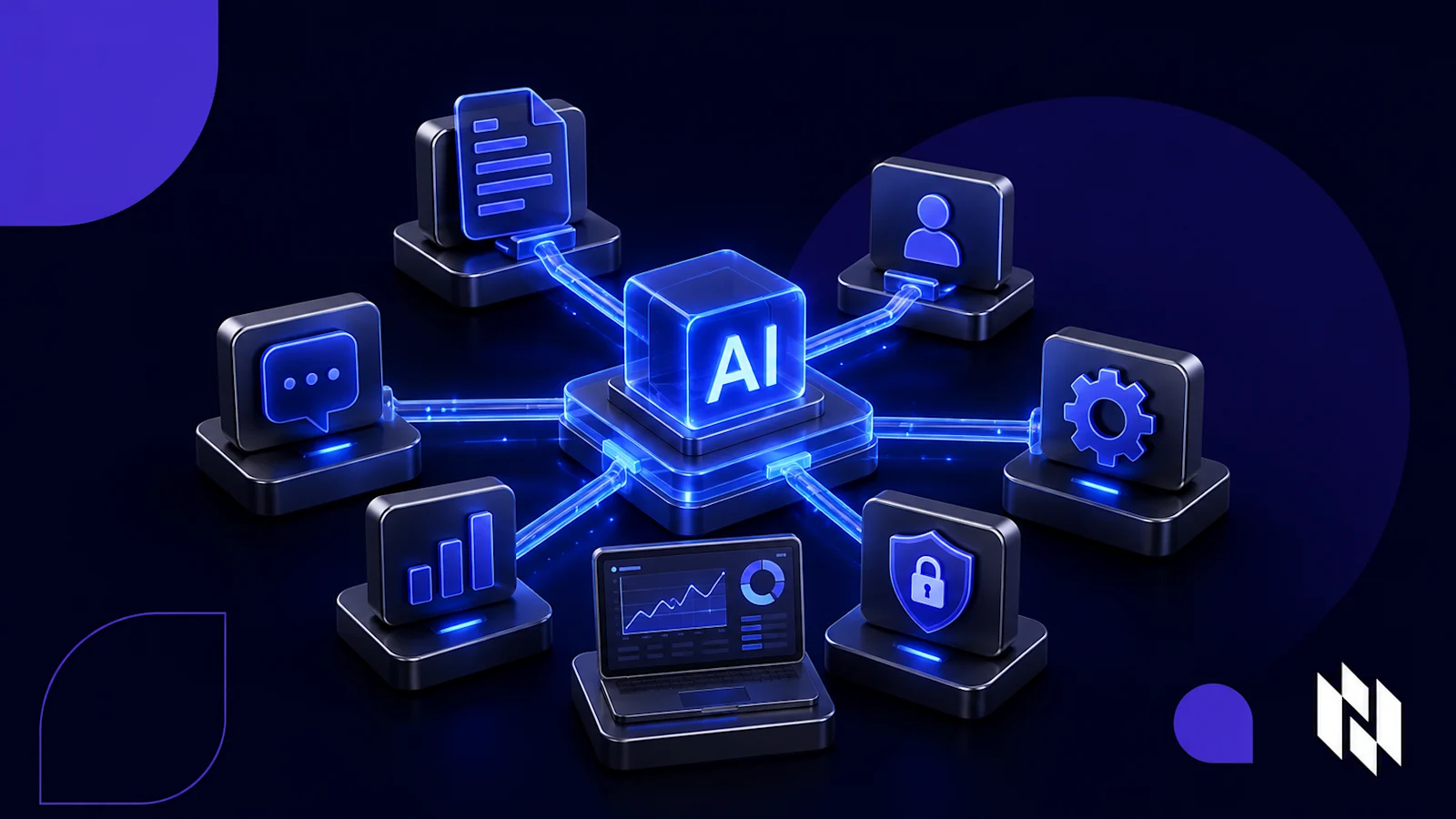
The AI Initiatives Enterprises Are Actually Prioritizing in 2026
A year or two ago, the AI conversation started with:
“What can we do with AI?”
Today, the better question is:
“Where is work breaking down inside the business, and can AI materially improve it?”
That distinction matters.
Most companies do not wake up wanting an AI agent, an MCP gateway, a vector database, or a fine-tuned model.
They have a business problem.
A team cannot keep up with inbound requests.
Employees spend hours moving information between systems.
Sales takes too long to produce proposals.
Executives cannot trust their reporting.
Engineering is buried under technical debt.
Knowledge exists everywhere but cannot be found.
The AI initiative only matters if it changes that situation.
Below are some of the most common conversations we are seeing and what the before and after can actually look like.
1. “We Know AI Matters. We Just Don’t Know Where to Start.”
The situation
Imagine a 500-person company where every department has started experimenting with AI.
Sales is using ChatGPT.
Marketing is testing content tools.
Operations wants automation.
Engineering is experimenting with coding copilots.
Leadership has 25 different ideas being thrown around.
But nobody can answer:
Which initiatives are actually worth investing in?
This is where an AI diagnostic and AI ROI study becomes valuable.
Before
The organization has:
dozens of disconnected AI ideas
no consistent way to evaluate them
pilots happening without clear business owners
unclear ROI
overlapping tools
no implementation roadmap
Leadership is interested in AI but increasingly skeptical because experimentation is not translating into measurable results.
What changes
An AI diagnostic looks across workflows, systems, data, labor requirements, and business objectives.
Instead of asking “Where can we use AI?”, the organization evaluates opportunities against things like:
hours of manual work
transaction volume
revenue impact
implementation difficulty
data readiness
integration requirements
risk
expected payback
A list of 30 ideas may become five serious opportunities.
After
Instead of scattered experimentation, leadership has something more practical:
Initiative #1: automate order intake Estimated 2,500 employee hours saved annually.
Initiative #2: AI proposal generation Reduce proposal turnaround from two days to two hours.
Initiative #3: internal knowledge assistant Reduce repetitive HR and IT questions.
Now AI becomes an investment portfolio rather than an innovation exercise.
The outcome: clearer priorities, fewer wasted pilots, and capital focused on initiatives with measurable ROI.
2. “Our People Spend Half Their Day Moving Information Around.”
This is probably one of the largest AI opportunities in the enterprise.
And it rarely sounds exciting when you first hear it.
The situation
Consider a healthcare, logistics, financial services, or manufacturing company receiving hundreds or thousands of documents every month.
Someone receives a PDF.
They open it.
Find six pieces of information.
Enter those fields into another application.
Check another system.
Send an email.
Update a spreadsheet.
Repeat.
Nothing about the individual task is particularly difficult.
The problem is that it happens thousands of times.
Before
A 15-person operations team might spend several hours every day:
reading incoming documents
extracting information
entering data
validating fields
updating ERP or CRM records
routing exceptions
following up manually
The company may have already explored traditional automation, but the documents and requests vary enough that rigid rules struggle.
The initiative
This is where AI workflow automation, agentic workflow automation, data entry automation, and form filling automation can converge.
An AI-enabled workflow might:
monitor an inbox,
classify an incoming document,
extract required information,
compare it against existing records,
validate information against business rules,
populate the ERP,
escalate exceptions to an employee.
After
Instead of employees processing every transaction, humans primarily handle exceptions.
A process that previously required six minutes of manual work might require less than one minute of human involvement.
At 50,000 transactions per year, that is not an AI novelty.
That is an operating model change.
The outcome: increased capacity without proportional headcount growth, shorter turnaround times, fewer data-entry errors, and lower cost per transaction.
That is what good agentic workflow automation should accomplish.
3. “Every Proposal Takes Forever Because Nobody Can Find the Right Information.”
The situation
A sales team receives an RFP from a large prospect.
The account executive needs answers about:
security
implementation
architecture
integrations
legal requirements
pricing
previous customer outcomes
So they start sending Slack messages.
Someone searches Google Drive.
Someone else finds an RFP from last year.
Security reviews 20 questions they have answered 50 times before.
Legal gets pulled in.
Three days later, the proposal is finally ready.
Before
The underlying problem is usually not writing.
It is fragmented organizational knowledge.
Information exists across:
previous RFP responses
sales collateral
product documentation
security questionnaires
implementation plans
contracts
pricing files
CRM records
Employees spend more time finding information than creating the final response.
The initiative
An AI RFP generator or AI proposal generator can connect this institutional knowledge into one governed system.
When a new RFP arrives, the platform can:
analyze the questions
retrieve approved responses
identify supporting documentation
draft answers
provide source references
route sensitive questions to security or legal
flag questions with low confidence
After
Instead of starting with a blank document, the sales team begins with a 70–90% complete first draft.
Subject matter experts review the questions that genuinely require judgment instead of answering the same basic questions repeatedly.
A response that previously took several days could be assembled in hours.
The outcome: faster proposal turnaround, more selling capacity, increased response consistency, and less dependency on institutional knowledge held by individual employees.
The AI isn't replacing the salesperson.
It is removing the administrative work surrounding the salesperson.
4. “We Have the Information. Nobody Can Find It.”
The situation
Ask an employee a simple question:
“What is our parental leave policy?”
They search Google Drive.
Then Slack.
Then the HR portal.
Then they message HR.
Another employee asks:
“How does this product integration work?”
Now someone searches Confluence, a PDF, and three old Slack threads.
The information exists.
The company just cannot reliably access it.
Before
Internal knowledge is distributed across:
Google Drive
SharePoint
Confluence
Slack
ERP systems
HR platforms
product databases
email
internal applications
Employees repeatedly interrupt knowledgeable people because finding the information themselves is harder than asking someone.
The initiative
An enterprise AI knowledge system can create a conversational interface across those systems.
But the actual engineering work goes well beyond building a chatbot.
You need:
data integrations
permissions
identity management
semantic search
vector search
knowledge architecture
source attribution
monitoring
This is where data engineering for AI becomes critical.
After
An employee asks:
“What is our parental leave policy for California employees?”
The system returns the answer, identifies the relevant policy, and links directly to the source.
Or:
“How do we integrate Product X with Salesforce?”
The system retrieves the right product documentation and implementation guide.
The outcome: less time spent searching for information, fewer repetitive questions, faster onboarding, better employee productivity, and institutional knowledge that becomes accessible instead of being trapped within individuals.
5. “We Have Tons of Data, but Nobody Knows What It Means.”
The situation
An executive opens a dashboard and sees:
Inventory variance: +13%.
Useful?
Kind of.
The next question is what really matters:
Why?
Now someone exports data into Excel, emails operations, calls finance, and spends half a day trying to determine what happened.
Before
Traditional ERP dashboards, MRP dashboards, and business intelligence systems are good at showing numbers.
They are often much worse at explaining them.
Executives receive:
hundreds of KPIs
static dashboards
lagging reports
conflicting data
manual spreadsheet analysis
The business technically has the information but still depends heavily on analysts to interpret it.
The initiative
AI-enabled analytics can sit above the reporting and data infrastructure.
Instead of only displaying a metric, the system can help investigate it.
For example:
“Why did gross margin decline in the Western region last month?”
The system can examine relevant operational data and identify:
product mix changed
freight costs increased
two customers received unusual discounts
one facility experienced higher scrap rates
After
Reporting starts moving from:
What happened?
toward:
Why did it happen, and where should we look next?
The outcome: faster decision-making, fewer hours spent manually investigating reports, and more leverage from data the organization already owns.
The prerequisite, again, is often strong data engineering, system integrations, and reliable underlying data.
6. “We Want AI, but Our Technology Stack Is the Problem.”
This one often surprises executives.
The situation
A company decides it wants an AI agent to interact with customer accounts.
The proof of concept works.
Then engineering starts asking questions.
Where does customer information live?
Three systems.
Do those systems have APIs?
One does.
Can the AI access order history?
Technically, but only through a legacy application.
Is the underlying data clean?
Not really.
Suddenly the AI project becomes a modernization project.
Before
The organization may be dealing with:
legacy applications
limited APIs
fragmented databases
brittle integrations
outdated frameworks
poor test coverage
years of technical debt
The AI prototype looked easy because it ignored all of those constraints.
Production cannot.
The initiative
This is where an architecture assessment, SDLC assessment, code modernization, and legacy application modernization become part of the AI roadmap.
The organization may need to:
expose legacy functions through APIs
modernize sections of an application
consolidate data
improve automated testing
restructure integrations
improve CI/CD
move workloads to more modern infrastructure
AI development tools can accelerate portions of this work, especially documentation, testing, code analysis, and refactoring.
But they cannot make bad architecture disappear.
After that, the company has more than one AI application.
It has a technology environment capable of supporting future AI applications.
Instead of every new automation requiring custom workarounds, core systems become easier to integrate with.
The outcome: faster future development, lower technical debt, easier integration, and an architecture capable of supporting AI-enabled workflows across the organization.
This is why we increasingly believe AI transformation and software modernization will become closely linked.
7. “Our AI Prototype Works. Now How Do We Safely Put It Into Production?”
This is the point where AI gets serious.
The situation
An internal team builds an AI assistant.
Initially, it only answers simple questions.
Then someone asks:
“Can we connect it to Salesforce?”
Then:
“Can it update an opportunity?”
Then:
“Could it issue a refund?”
The AI has gone from answering questions to taking actions.
The risk profile changes dramatically.
Before
Many AI experiments begin without clearly defined:
access controls
logging
permissions
security testing
data governance
human approval
model monitoring
That might be acceptable for experimentation.
It is not acceptable for production systems interacting with sensitive data or business applications.
The initiative
Organizations increasingly need an AI security assessment and ongoing AI security testing.
That includes evaluating:
sensitive data leakage
prompt injection
tool permissions
unauthorized actions
authentication
model providers
compliance
logging
data retention
As the number of agents grows, technologies such as an MCP gateway can also provide a centralized governance layer controlling how AI applications interact with enterprise tools.
After
Instead of giving an agent broad access to company systems, the organization establishes defined permissions.
For example:
The agent can read customer information.
It can draft a refund.
But a human must approve the transaction before money moves.
Every action is authenticated and logged.
The outcome: organizations can move AI from experimentation into production without giving autonomous systems unrestricted access to critical business processes.
An Emerging Problem: Everyone Can Build Software Now
There is one more conversation we expect to become much larger.AI coding tools have made application development accessible to people who would never previously have written software before.
That is enormously powerful.
It can also create chaos.
Imagine an operations manager builds an internal application using Replit or another AI development tool.
It works.
Their team starts using it.
Six months later, it contains customer information, integrates with Salesforce, and has become critical to the department.
Then the employee leaves.
Who owns it?
Who reviewed the security?
Where is the source code?
Who maintains it?
This is the emerging idea behind a Citizen SDLC.
,Companies need a lightweight path where employees can prototype with AI while engineering and IT establishes requirements around security, ownership, testing, production deployment, and maintenance.
Before: shadow software spreads throughout the organization.
After: employees can innovate rapidly while production applications still follow appropriate engineering governance.
The goal shouldn't be preventing employees from building.
It should be creating a safe path for the best ideas to become real software.
Where Does Model Fine-Tuning Fit?
Interestingly, one initiative we don't think most companies should start with is model fine-tuning.
Consider a company that wants an AI system to answer customer questions more accurately.
The instinct might be:
“We need to train the AI on our business.”
lacksBut the real issue may simply be that the model doesn't have access to up-to-date company information.
Before fine-tuning anything, the company should usually explore:
better prompts
retrieval-augmented generation
improved source data
better knowledge architecture
structured context
workflow redesign
Only once those approaches reach their limits should fine-tuning become a major consideration.
Before: the business assumes it needs a custom model.
After: it realizes better architecture and access to the right data solve most of the problem at a fraction of the complexity.
The Common Pattern
Look across all of these examples.
The companies weren't really asking for:
an AI agent, an MCP gateway, a fine-tuned model, or a vector database.
Those were technical answers.
The problems sounded more like:
“We're hiring people just to process paperwork.”
“Sales spends days responding to RFPs.”
“Nobody can find anything.”
“Our reporting tells us what happened but not why.”
“Our legacy systems are preventing us from moving faster.”
“People are building AI tools everywhere and IT has no idea what's happening.”
That is a much more useful way to think about enterprise AI transformation.
Start with the operating problem, understand the workflow, then determine what combination of AI, automation, custom software, data engineering, integrations, and modernization actually solves it.
How Nx Growth Partners Thinks About AI
At NxGP, we try to avoid starting with the technology.
We start with three questions:
What outcome needs to change?
Revenue, cost, capacity, speed, customer experience, risk, or another measurable business metric.
What is preventing that outcome today?
The people, workflow, technology, data, handoffs, and systems involved.
What is the simplest intervention that materially improves it?
Sometimes that means an AI agent, workflow automation, building an internal application, connecting existing systems, and sometimes the most important AI initiative starts with modernizing the software and data underneath it.
That is ultimately how we believe organizations should approach AI transformation.
Don't start by asking where you can deploy AI. Start by finding where the business is unnecessarily expensive, slow, manual, fragmented, or constrained. Then fix it.
Recognize one of these problems inside your organization?
Nx Growth Partners works with companies to identify high-value AI opportunities and turn them into production systems across AI workflow automation, custom software, data engineering, system integrations, and software modernization.
If one of the situations above sounds familiar, let's map the workflow and determine whether there is a real business case behind it.